Assassin's Creed
- Developer: Ubisoft Montreal
- Genre: Arcade/Action
- Originally on: Windows (2008)
- Works on: PC, Windows
- User Rating: 10.0/10 - 1 vote
- Rate this game:
Game Overview
OH HELLO, it's Assassin's Creed. Finally decided to show your face at the PC party, did you? And what's that you've brought with you? It had better be steaks and blow jobs for all of us impatient PC gamers, because you've kept us waiting a pretty long time. A whole six months you've been sitting inside the oven of development, and what have you got to show for it? Certainly not sirloin and fellatio, but four new kinds of mission and a fast travel system instead. You're just lucky you're so goddamn pretty.
A lot of people will have, at the very least, peripheral knowledge of Assassin's Creed. Released on the Xbox 360 back in 2007, it elegantly rode the crest of an immense surge of anticipation before washing up on a pristine beach of great sales figures. But this beach resides in the cove of unfulfilled expectations - this was one of the most powerful examples of style over substance you could ever hope to gawp at. Ubisoft claim that those six months of conversion limbo have been used to address such criticisms though. They claim we PC gamers are getting the definitive version.
The thing is, the substance really wasn't all that lacking - it's just that the style was laid on so thick, the poor substance could barely hope to match up. Anyone with an eye for beauty couldn't fail to be won over by this big, stylish bastard. Assassin's Creed is an alarmingly beautiful game; even using Massive Attack's Teardrop in the TV ad didn't even seem pretentious.
JEWOOSALEM
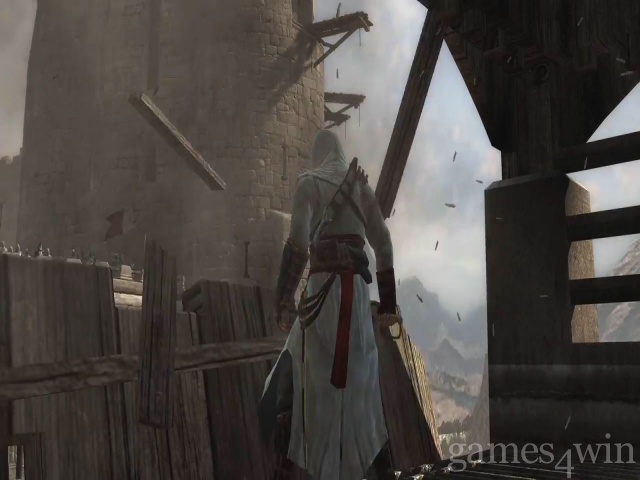
The setting, if you're not already familiar, is a generous slice of the Crusade-era Middle East squeezing in three huge cities and a menagerie of smaller towns and outposts across the surrounding countryside. You play Altair, the strongly characterised and hooded assassin, who is part of a society of becloaked hitmen who maintain world order by blending in with massive crowds and stabbing folks in the neck. However, Altair's reckless attitude towards the rules of his profession sees him badly muck up. So the game is his attempt to redeem himself.
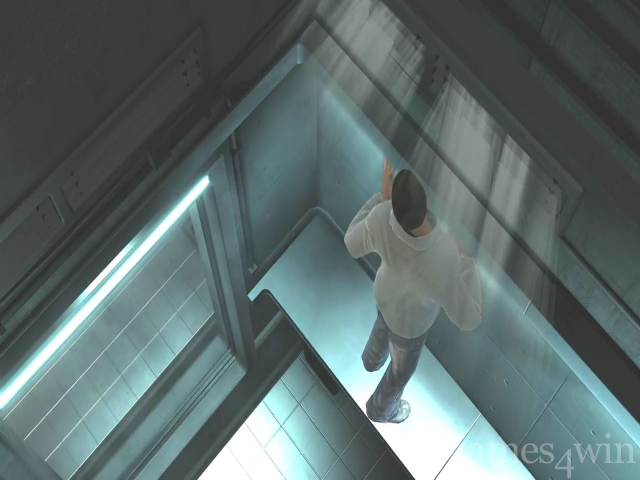
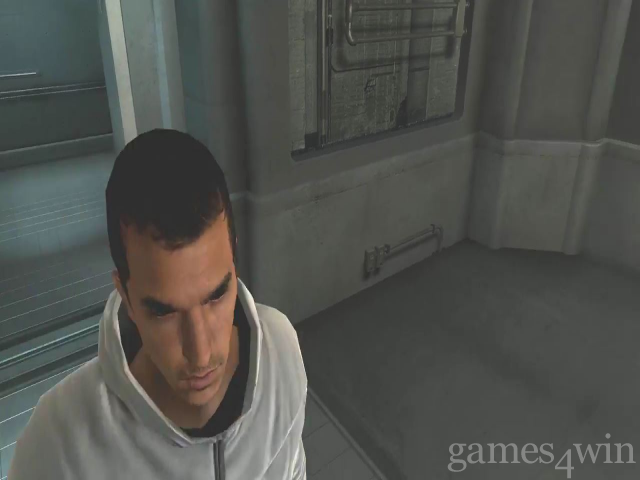
Except the Crusades isn't really when the game is set - the true setting is the near future, and your true character is a descendant of Altair, who's accessing his ancestor's memories through a (rather silly) genetic memory recalling machine. The slowly unfolding story plays out in both timelines, though in the present day you're trapped in a stainless steel laboratory. The tale is ridiculous, but it's so far-flung that you can't help but nod in admiration. How Ubisoft are really hoping to impress you though, is through the two-fold implementation of both crowd dynamics and free running acrobatics. Jerusalem, Acre and Damascus are the game's three atmospheric cities. They're sprawling urban i playgrounds - every wall and rooftop is effortlessly scaleable, giving you free reign to carve your own path through the city with unerring fluidity.
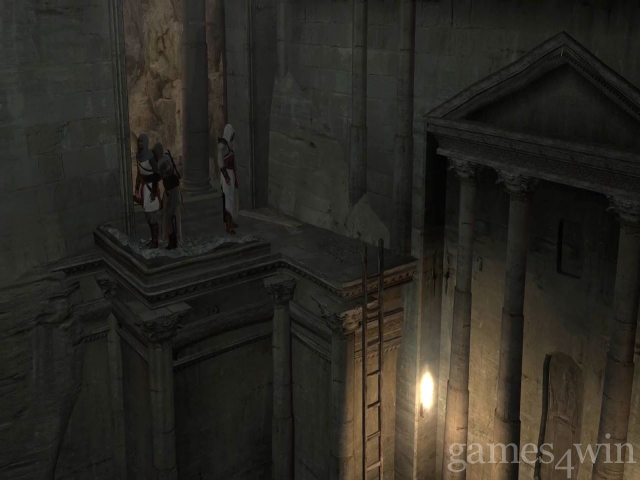
This parkour travel system is a technical marvel, as your character's hands and feet connect neatly with every ledge and crevice and every jump and swing is seamlessly blended into the next. The climbable surfaces aren't signposted and labelled with vines, big blue circles, or what have you - they simply exist in the form of regular brickwork and architecture. Assassin's Creed allows you to rethink the ways you move your character about the game world, from a go-anywhere, climb-up-anything sort of perspective.
The fug of adrenaline that follows a successful assassination sees you bounding away from the scene of your crime like a man-sized squirrel, desperately seeking refuge by darting across rooftops and down alleyways at a spirited pace. The game takes enough control out of your hands to make it more a matter of choosing the direction in which to scarper, rather than have you micromanage your limbs and time every jump precisely. You could, in theory, hold down three keys and watch Altair do a fully automatic parkour prance across half a city, all by himself. The result is a highly technical, stylised and flowing feel to the game, something in which the developer's previous title, Prince of Persia: SOT. dabbled regularly.
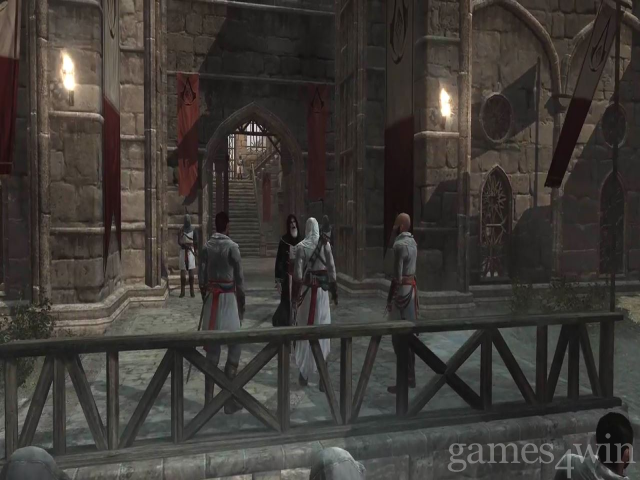
The crowds are rendered with similar attention to detail, allowing you to walk in and around the thronging mobs with nary a clipped polygon to be seen. Altair deftly places hands on nearby shoulders, and twists his upper body to gently and discreetly manoeuvre his way past people. Such smoothness gives you a weighty sense of self in a beautifully detailed world, and makes you realise just how forgiving you are of the rough-edged animations that fill almost every other game you've ever played.
REMEDIES
So these problems with the Xbox version, the ones Ubisoft said they'd do their utmost to patch up for the PC. What were they and have they been scrubbed right off? Well, having played both versions to completion I can speak with cocksure impunity.
First off, the sense of control over Altair given by the 360 as he flips through the Middle East was jarringly minimal and the clambering was fairly autonomous. This hasn't changed, though the paring down of complexity is probably necessary, given that with a bit more control you'd be fecklessly hurling Altair into spikes and down wells with the acrobatic skill of a mental patient. Enough control is afforded in choosing your escape routes anyway, especially when you're using your acrobatic abilities to escape guards and soldiers. And, lest we forget, it looks amazing when you do it. Then there's the rigid and systematic mission system, which finds itself at odds with the freedom on offer in other aspects of the game. Once you've reached a city you must find a vantage point - usually a spire or tower - to unlock mission objectives within a certain radius. These objectives require you to pickpocket, eavesdrop or intimidate, and all are activated using artificial-feeling key presses. By carrying out these simple missions you gather intelligence and once you've got enough, you unlock the assassination mission.
Such a paint-by-numbers approach to murdering a man is grating in what is otherwise a sandbox world, and the routine of driving Altair to these viewpoints and effectively repeating the same gamut of missions continues throughout most of the game. The new PC-exclusive missions do very little to remedy this, having you destroy a required number of market stalls, or assassinate archers, or just collect flags - they're minigames at best Also, one of the missions is voiced by an Irish guy, and I'm not sure how historically accurate that is.
IN CONTROL
Ubisoft have gone to great lengths to adapt Assassin's Creed to PC - but as much as we appreciate the effort they've tripped up at a few key points. If you're not endowed with a widescreen monitor you'll be stuck with looming great black borders, which might look cinematic, but ultimately make it feel like you're playing from inside a post box.
The control system, originally designed to work specifically with the Xbox control pad, has been exported to the keyboard in ratheran awkward fashion. What was once mapped to four simple buttons now finds itself spread across various keys surrounding WASD, while the right mouse button acts as the gear change between low-profile actions (gentle pushes and blending) and their high-profile counterparts (sprints, jumps and fights). Where Gears of War made the transition from gamepad to mouse seem effortless, the mouse and keyboard combo simply doesn't feel ideal for Altair.
The assassinations aren't what you'd hope for either, wonderful I characters though the victims may be. Rather than stealthily approaching your target and eliminating them with as little fuss as possible-like the creed suggests - your victim nearly always puts up a fight, or forces you to fight your way past their guards.
Occasionally you'll pull off a quick kill with your wristblade and feel brilliant about yourself, but all too often you'll be chasing your screaming target through crowded streets, knocking people over and waving your sword about like a twat. Rarely do you feel that you've done what the game intended you to do, and instead you find yourself blundering about, assassinating nothing but subtlety. The fluidity so carefully threaded through the rest of the game just doesn't appear in the construction of the missions and that's Assassin's Creeds greatest problem.
LAZARUS TRICK
Then again, the game has its free-running, crowd-dodging tricks, and pulls them out every time your interest slackens to astound you in such a spectacular and visual way to prevent you ever realising that, if you were to peel away the splendour of its cinematic presentation, Assassin's Creed becomes a plain, nothingy sort of game. While it sounds unbelievable that the look and feel of a game could overpower its underlying dryness, it does. And freguently enough to make the game well worth playing.
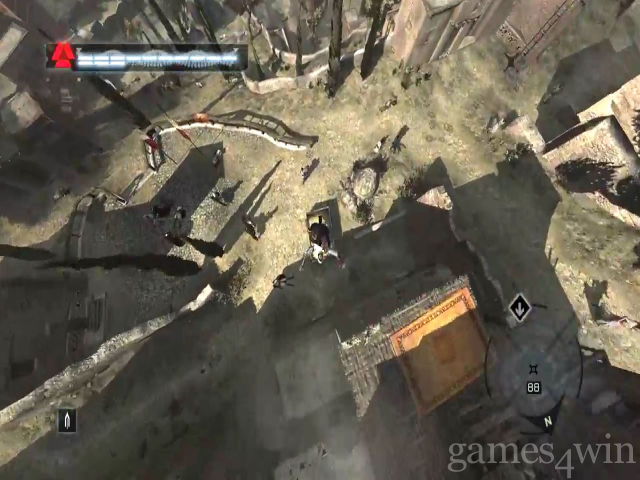
Take this one occasion in the city of Acre, the Crusader stronghold: having spotted the huge church spire dominating the skyline, you traverse a mile of rooftops to get to it before navigating the church's tricky religious architecture. Getting ter the peak of the spire takes a good five minutes, which tapers off to a nice big cross which you can then climb over using nothing but your blaspheming limbs. Perched at the very tip, with just enough space for his feet, Altair crouches and balances while his assassin's garb flutters in the wind. The city far below you lies unfolded and expansive, from its guarded gates to its busy docks. Torn clouds roll across the sky, casting great sweeping shadows across swathes of the landscape.
A tangible sense of drama in games is rare, and Assassin's Creed freguently beams profundity from every pixel it can muster. The notion that you could go down into any of these streets and start putting your hands on people's shoulders is dizzying.
And easy as it is to clearly outline the game's faults, it's more difficult to pinpoint exactly what makes it great fun to play. Just when the sense of repetition stretches the illusion past its elastic limit, Assassin's Creed pulls a moment of faultless graphic flair out of its gorgeous hat and it immediately becomes a delight to play again.
The fighting system is one such saving grace, working around a deceptively simple framework of blocks, ripostes and attacks which combine to form a more impressive array of visually enticing moves. You time your mouse clicks to coincide with the clashing of swords to initiate a combo, which culminates in one of several fatal.
Tarantino-inspired attacks. Altair runs swords through chests, slaps his foes before j backstabbing them, breaks their legs at the i knee, gouges fleshy chunks from necks - it's a grotesque display, enhanced by the cinematically aware camera angles and increasingly bloodied steel. So is this the definitive version? Well, in some ways it is. You can plug in a control pad if the controls bother you that much, it's running at a higher resolution than the Xbox version (despite the forced widescreen) and it's got some extra mission types thrown in, and when both timelines intertwine it makes for a intriguing storyline (and one whose blunt ending blows the doors wide open for the rest of the trilogy).
You can pick away at the game's faults, much as you might criticise the individual ingredients of a fine custard tart, as the performance issues and demanding system specs are just too blatant to deny. But if you forgive the tardiness, you'll find Assassin's Creed remains luxurious and sweet. The spectacular way in which the game is presented is enough to make most players want to overlook the deep-running problems it harbours and plaudits must be paid to a setting this original and so excellently realised. However, for many this will be too superficial a game to provide anything more than somewhat hollow entertainment.
Caught in the act
How the stealth is dealt
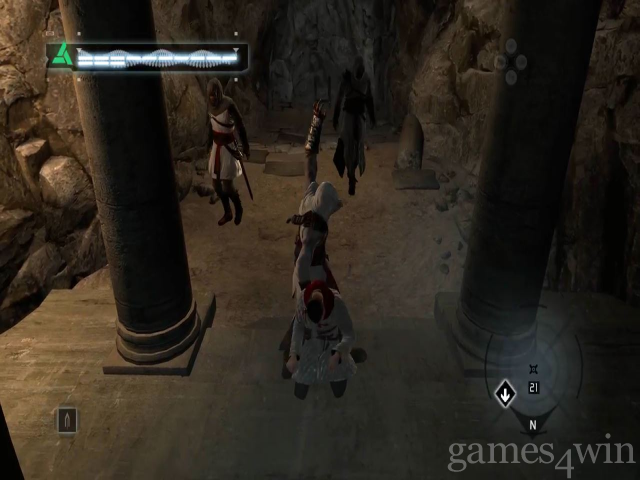
The stealth system in Assassin's Creed is more an indication of how aware those around you are of your presence, rather than how hidden you are. A yellow indicator means you're being watched by a guard - fairly normal circumstances, as the guards watch everybody. Start a fight while being watched and the law turns a blind eye, but pull a weapon and they're forced to get involved.
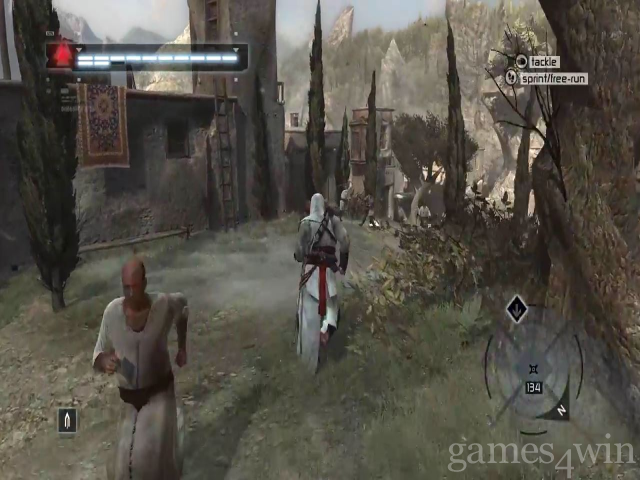
A red indicator means guards are suspicious and any strange action undertaken by you will get you immediately noticed - this happens, for instance, when a guard discovers a dead body. Do backflips during this phase and you'll move on to the flashing red triangle indicator, which means you're being chased and guards want you dead. Flashing yellow means you're being chased, but nobody can see you - in these cases you can dive into a roof garden or pile of hay, blend in with monks, or sit on a bench to give your pursuers the slip.
This all works extremely well, and logically too - traipsing about on rooftops, guards will rationalise, is exactly what the murderer would do.
Monks and vigilantes
A civilian in need, is a civilian indeed
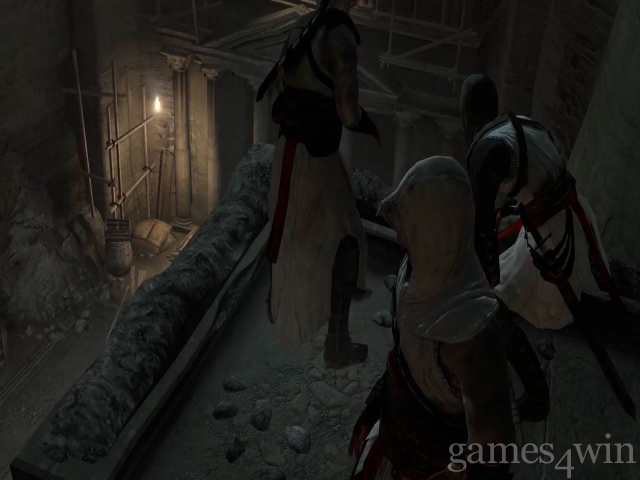
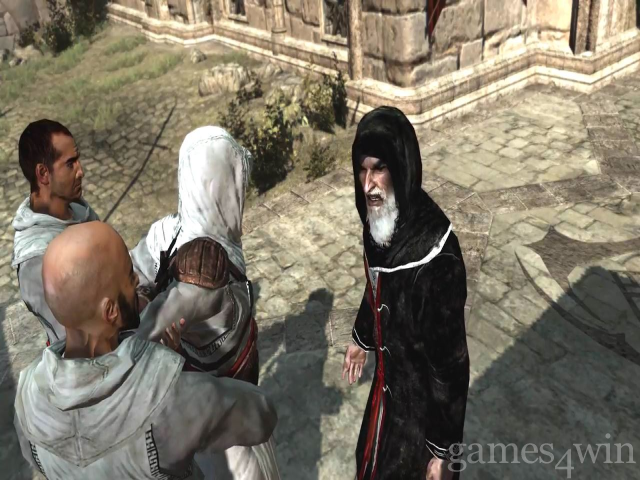
Scattered about cities you'll find citizens being harassed by soldiers. Saving these people by slaughtering the soldiers is in your best interest as doing so 'unlocks' one of two things during missions. The first are monks, who are dressed similarly to Altair. They'll let you walk with them, head bowed, past guard posts. This is usually the only way of getting to certain areas undetected and so monks will always be lurking nearby. The second are vigilantes, who will start fighting with any guards chasing you.
'Unlocking' people is another way in which Assassin's Creed feels worryingly artificial, because in real life people aren't unlocked, they're born. The game half plays it off as those characters suddenly appearing in your jogged genetic memory, but really, who'd forget this many monks? And what is it about beating up other men that makes you remember deeply supressed memories? This doesn't add up!
System Requirements
Processor: PC compatible,
OS: Windows 9x, Windows 2000 Windows XP, Vista, Win 7, Win 8, Win 10.
Game Features:Single game mode
Assassin's Creed Screenshots
Windows Screenshots
 S.T.A.L.K.E.R.: Clear Sky
 Mercenaries 2: World in Flames
 Medal of Honor: Pacific Assault
 Serious Sam 2
 Prototype
 Aliens: Colonial Marines
 Damnation
 The Regiment